The Best Part: Production So Far
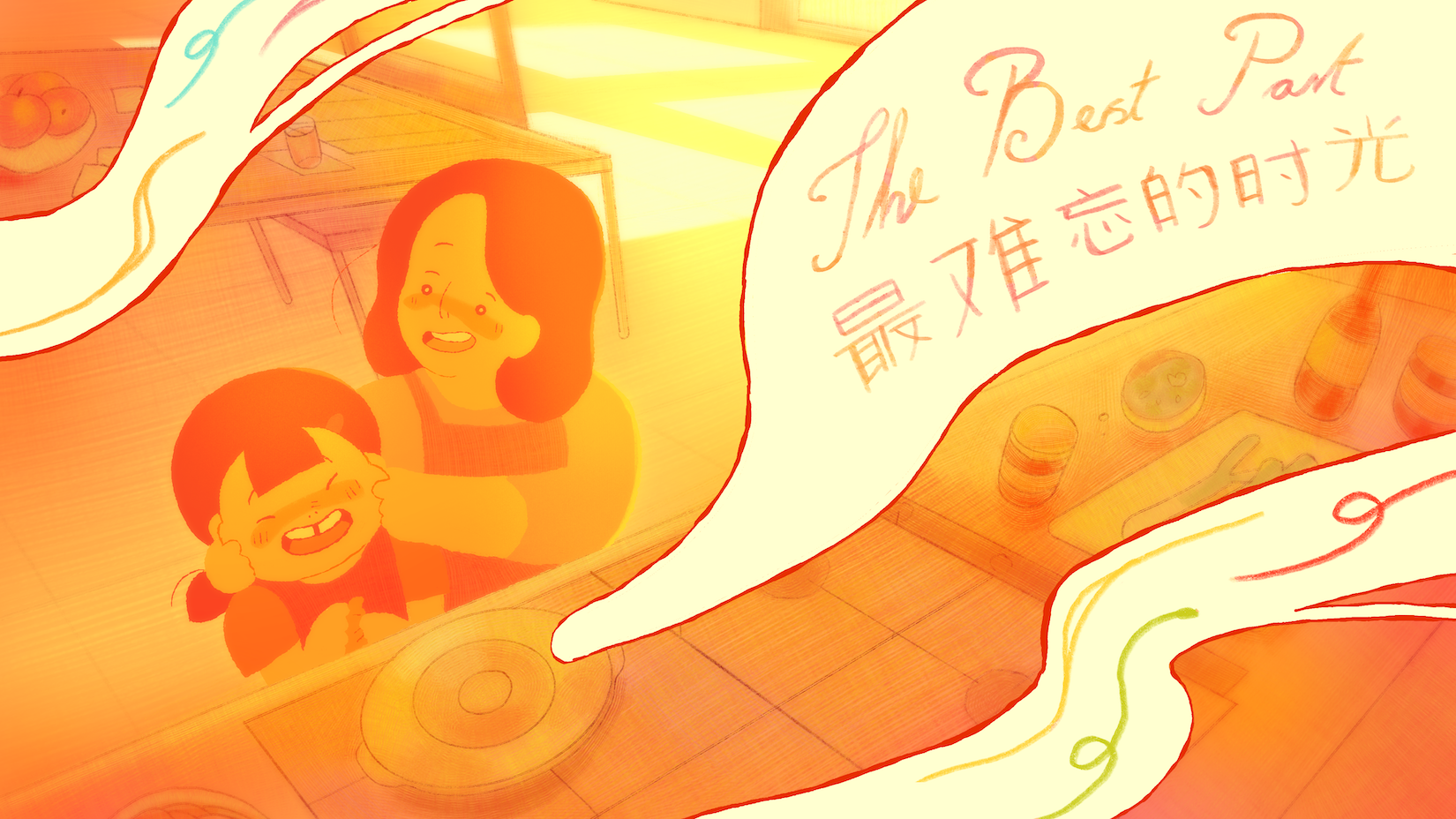
When Lilian Han Morze approached me and asked me produce for her film ‘The Best Part’ if her pitch went through, I was more than happy to oblige – on a few conditions.
I loved the look and themes of the film. It integrates colour into the story beautifully, and the themes are incredibly touching. And, from a producer point of view, I think it will be very marketable at festivals! However, it sounded like it would end up being quite long – longer than the recommended 3 minute film we were supposed to be making, in any case. Whilst I have confidence in my skills as a producer to get something longer than that finished, I didn’t want to take on something that would end up being a herculean task. Therefore, I gave Lilian two requirements before I signed on to produce:
Make an animatic for the whole film to check timings.
If it’s over 5 minutes, cut it down.
Lilian agreed, and when she showed me the animatic (which she did have to cut down), I cried. That was the moment I knew I would put my all into this film.
After being greenlit and gathering a core crew of four fellow students to add to Lilian and myself, the first thing to do was have an induction meeting.
How I prepared the team for success from the get go
Naturally, a large portion of our induction meeting was chaired by Lilian, the director. After she had finished running through the story and her artistic vision, though, I took advantage of the opportunity to speak with our core crew. I had worked with a few previously, but not the majority, and so I wanted to be clear with what my expectations were of everybody when scheduling as well as wanting to get to know each individual’s strengths and weaknesses.
After thanking everybody for joining the film and getting them all excited about getting it done, I first laid out the following expectations. Some of these will sound obvious, but remember, these are university students we’re dealing with! Nobody is on a contract and nobody is getting paid.
Come in to the studios every day – don’t work from home unless you have extenuating circumstances. Similarly, treat your work on this film as a 9-5 and put the hours in.
Come to every meeting, even if you don’t feel that there is anything to discuss.
Work must be completed on time. If you won’t be able to do it, and somebody else has finished their work for the week, expect to have the work re-assigned.
Be willing to pick up somebody else’s work if you have time and it’s needed. We’re a team, and should be helping each other out!
Always update your task status on tracking sheets and ask for feedback.
Communication is of the utmost importance: if you have an unexpected appointment, or have too much work on your plate, or even if you won’t be able to finish your work because you’ve been too busy playing video games, I need you to tell me so I can reshuffle tasks. No disappearing off the face of the earth because you don’t want to admit to procrastination!
With those key things being covered, we had a discussion about everybody’s strengths and weaknesses. I noted down each crew member’s preferred work, the work they felt they were best at, the work they felt they were fastest at, and also anything they really didn’t enjoy doing. Of course, I couldn’t guarantee that they would only be assigned to things they liked – but a motivated worker is a faster worker, and so I assign tasks as per people’s preferences as much as possible. I also made sure to find out if anybody wanted to do anything specific for their portfolio, as it’s important to me that the team feel they benefit from the project.
After that, it was a simple matter of running through the timeline, meeting times each week, what softwares we would be using and so on and so forth. We also, of course, brought snacks – a poor decision, perhaps, as after that it became a bit of a habit for every meeting. Good for motivating the team, but not good for my wallet!
The Timeline
A little run-through of my Gantt chart, and the decisions behind it.
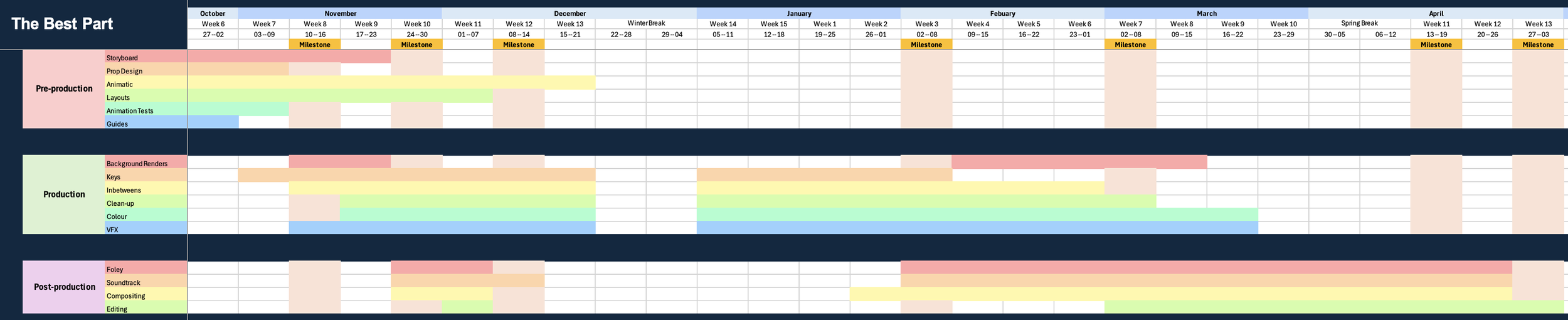
Some deadlines to be aware of: we had to hand in a 30 second vertical slice on December 14th, and then hand in the completed film on May 2nd. All other milestones on the Gantt chart represent progress screenings with lecturers.
Because of how the university announced the greenlit pitches, the very first week was a bit all over the place. The announcement came in the middle of one of our reading weeks, so most students were away, and the method of crewing up manifested as lots of messaging other students and asking if they would want to work on the film. As such, in this first week I asked the director to focus her efforts on making any necessary guides and bibles that artists would need, as well as doing a few basic layouts from the storyboards. Crew members – once they had joined the project – were asked to do a few turnarounds of the characters to get into style. It wasn’t until the following week, when everybody returned, that we properly fired up the project.
The director had gotten a lot of feedback on the animatic from lecturers and peers alike before pitching it, so we felt quite confident that there would be no major changes – something I had had an issue with in a previous project. However, we wanted to wait until after our first progress screening to confirm that.
What tasks did I assign for the time being then?
Well, there was one key part of the animatic which the director knew, without a doubt, that she did not want to change: the film’s precipice, and the point that made all of the crew cry when watching the animatic. As luck would have it, this sequence of shots happened to take place in a liminal space which, in short, would not require any background layouts before animating.
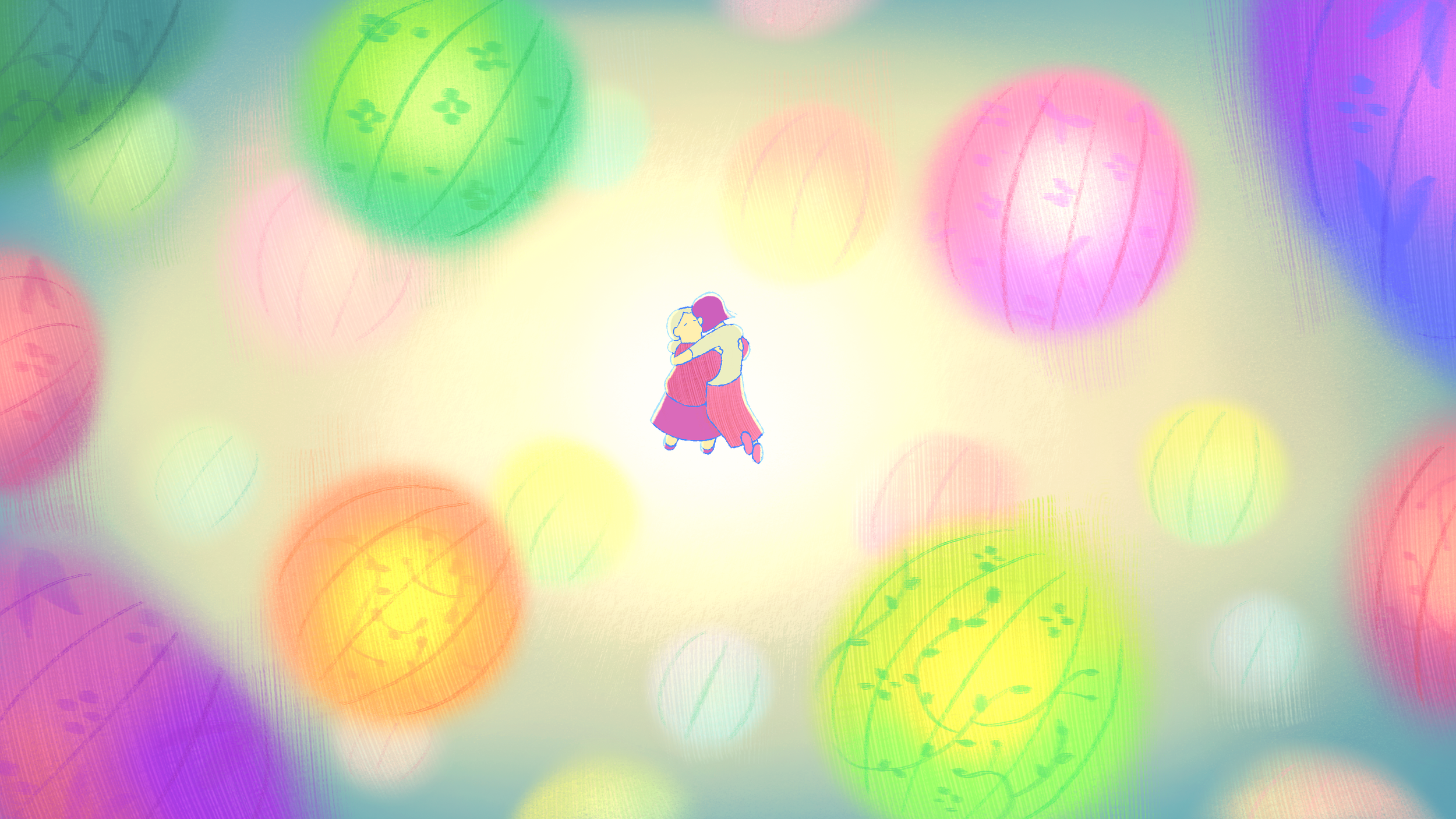
So, this is where I started with task assignment: I got our animators to work on a 30 second segment from this sequence, starting with keys just in case of any changes before moving onto inbetweening.
Another thing we worked out very early on in production was the trailer. I’m happy to say that I’m the one who put together our trailer animatic! It would be months until we released the trailer, but the reason I wanted to get a plan for it put together was so that I could assign those shots for animation. In the case that we had started work on any of these shots and then they got cut from the film, there would be the peace of mind that it was not a waste of labour as it would still be used in our trailer. Layouts for these shots were done whilst the 30 second segment mentioned above was worked on, and then animators were able to move on to these new shots when they finished up the vertical slice content.
The animatic was soon picture locked, and from that point we’ve just been powering onward! I pushed background renders – other than the ones for the trailer – to start after keys were finished, as I wanted to focus people’s time on animation when it was at its most full-on. With keys done, there is more time for people to pick up background renders. The completion of keys will also see the start of sound production work, although this won’t properly fire up until after every shot has been roughed.
The schedule should, if all goes to plan, see us with lots of time near the end for compositing – something which often ends up being a crunch period! I’m very happy with how the film has gone so far, and feel blessed to have such a fantastic team. Before I end this post, though, there’s one more thing I want to touch on…
Crewing Up: Voice Actors, Sound Designers, Composers and Freelancers
Recruiting talent for the film is, of course, a vital part of any production. At Falmouth University, where I study, we are often able to reach out to other courses – Acting, Post-Production, Music and so on – and students on these courses can work on the film in exchange for module credit. This is a budget-friendly way for students to get good people working on the film, and is, in fact, the route through which I found our sound designer. However, it was not the same story for everybody else.
I reached out to our composer because I knew he had worked on a friend’s film, and I had been so incredibly impressed with his work. Whilst I had never met him, I popped him a message in which I essentially pitched the film and asked if he would be interested. I was unsure if he would be as I knew he was busy with a job alongside other freelance projects, but fortunately he agreed to a call and the director and I were able to bring him on board. It just goes to show that you should pay attention to not only your own network, but the people within your network’s network!
Our voice actors: where to begin? We found each of them through a separate avenue. We needed three, all women, and all different age ranges. As the film is deeply rooted in her own Chinese heritage, our director wanted the voice actors to be asian so that we could uplift Asian voices.
Not an easy ask in Cornwall!
We made a slight compromise: we would make an exception to this rule for our voice actor for ‘young Mei’, as we agreed that it’s already hard enough to find an adult who can do a convincing 5 year old voice! And, funnily enough, this was then the voice actor we had the easiest time finding. She reached out after we met her at a networking event at the university, and was happy to come along and record some lines for us.
Yulin Ng is the voice of our main character Mei for the majority of the film, and she’s absolutely fantastic with loads of experience under her belt. We were really struggling to find an Asian actress who we liked, so when I stumbled across Yulin’s page I was both delighted – she seemed perfect! – and downtrodden – surely she is far above the level of doing student films. However, I’m not afraid of a cold email. I pitched the film to her, pulling on the relevance of it to the values she mentions in her website, and held my breath for her response. When it came, saying she was very interested and would like to have a call to discuss it more, the director and I both couldn’t believe our luck. We had a very productive call with Yulin – she’s based in Singapore, so would be recording from her own studio – and we managed to sign her on to the project. Two down, one to go!
Our final actress isn’t actually an actress at all – she’s a local mum! To add to the film’s authenticity, we wanted the voice actor for the mum to be an actual Asian mother. Knowing I would be unlikely to find anybody who fit that bill within the university’s acting course, I put out a casting call to the Falmouth community Facebook page. After a few days of no luck, my phone buzzed with a new message: a lovely local mum, who had moved here from Hong Kong, offering to help out. She is brilliant! I took her out for coffee before we recorded anything to get to know her, and wow, what an amazing life she’s lived. It doesn’t happen all the time, but every so often I find that this industry allows me to meet some fascinating people and I feel so grateful for it. We weren’t the only people who benefitted from this arrangement – she was very excited to be shown around the university!
So, one voice actor from the university, one from Singapore, and one a local mum. What a range! It was a great experience to explore all these different avenues, though, and I’m very glad to now have these women in my network.
One final thing then: our freelancers! These are the lovely students in the years below us at university who have been inducted into the project who are all great sports in helping out. I arranged an advent calendar for them all as well as getting them involved in promotional videos amongst other things to ensure they all felt part of the team. A little bit of work here and there really adds up.
So, in total, that’s 27 people working on the project – and 27 people for me to manage!
It’s a big step up from the projects I’ve produced previously, but I’ve welcomed the challenge with open arms and feel that I’ve taken it in my stride.